I write about leisure stacking, so when the idea of book stacking showed up in my YouTube Shorts feed, it caught my attention right away. Pairing small habits so they make each other easier is exactly what this site is about, and book stacking does that for reading.
It turns out there is more than one way to stack books. Below are two approaches from two YouTube creators, how they compare, and a simple way to try each one.
Approach One: The Hard, Medium, and Easy Stack
The version that first hooked me comes from YouTuber Odysseas (@odysseas__), who shared it in a YouTube Short. The credit for this three book idea goes to him. The original Short is no longer available on YouTube, but you can find more of his work on the Odysseas Shorts page. His channel covers reading skills, book insights, and learning techniques.
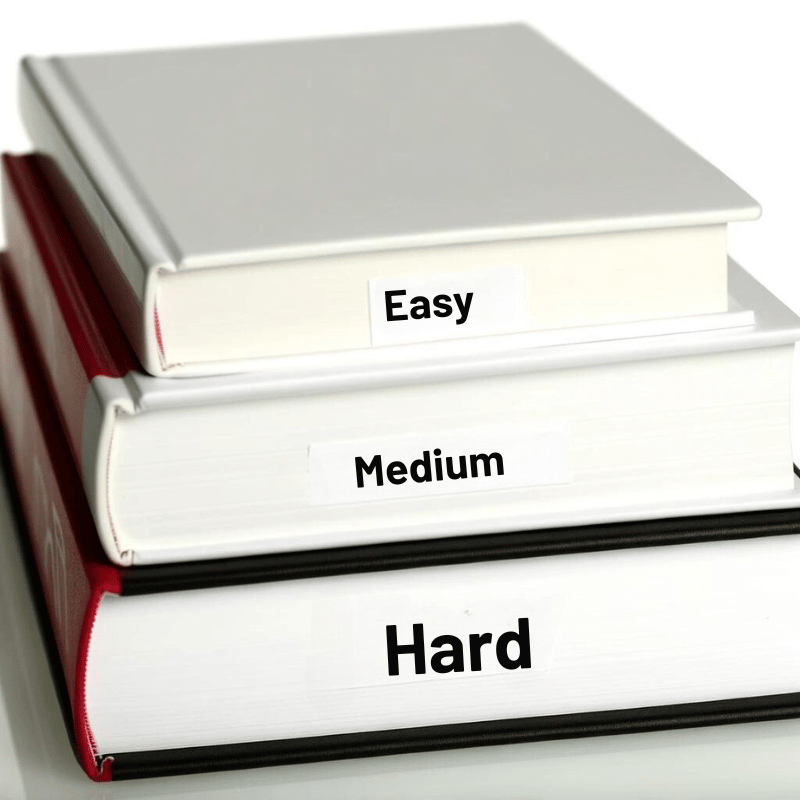
The idea is simple: always keep three books at hand, one hard, one medium, and one easy. When you sit down to read, start with the hard one. When you have enough ideas to ponder or you hit a wall, switch to the medium one. When you have had your fill of that, head to easy street with your easy pick.
How to Try It
- Pick three books: one that stretches you, one that takes moderate focus, and one that feels like a treat.
- Keep all three in one spot so switching takes no effort.
- Each session, begin with the hard book while your mind is fresh.
- Move down to medium, then easy, as your energy fades.
- When you finish a book, replace it with another of the same difficulty.
My First Book Stack
Hard: The Idiot by Fyodor Dostoevsky. I loved Crime and Punishment, so I have to read another Dostoevsky novel.
Medium: So Good They Call You a Fake: Command Attention, Monetize Your Talent Stack, and Become the Uncontested Authority in Your Niche by Joshua Lisec. This is the first nonfiction book from a highly paid, prolific ghostwriter.
Easy: Agnes Grey by Anne Brontë. It is the shortest of all the Brontë novels.
I could tell book stacking was working for me because, between starting and finishing the first version of this article, I had already read several chapters each of my medium and easy picks.
Approach Two: The Flexible Pile
Another take comes from Mr Clark of the YouTube channel Mr Clark’s Classroom, a teacher, coach, and mentor who has taught philosophy for ten years. Instead of exactly three books ranked by difficulty, he keeps a small pile going at once, with each book serving a different purpose.
His stack mixes professional reading, books for personal growth, philosophy, psychology, business, and a novel for when his brain is tired. When he showed his pile, it held a huge book on psychology and religion of nearly 800 pages, a short business book, a slim philosophy title, and a science fiction novel from the Dune series. The point is that whatever his energy level, there is always something on the pile that fits, so he reaches for a book instead of his phone. As he puts it, “the question isn’t should I read tonight or not, the question is now what shall I read tonight.”
A few other parts of his method stood out to me:
- Keep replacements waiting. Short books finish fast, so he keeps the next title ready to slide in and keep his momentum going.
- Weigh more than difficulty. He considers the challenge of the material, the length, the type of book, and how emotionally heavy it might be.
- Set an intention. Know why you want to read more, whether it is for work, self discovery, less screen time, or pure fun.
- Let it be messy. This is not about perfect notes or remembering everything. It is about choosing to read, over and over, until it becomes part of who you are.
Three or four books is his sweet spot, but he encourages experimenting. For you it might be one or two, or nine or ten.
How to Try It
- Write down why you want to read more this year.
- Choose a handful of books that each serve a different reason or mood, including at least one easy, fun read.
- Each time you sit down, pick whichever book matches your energy right now.
- Keep a next book waiting for each slot so finishing one never stalls you.
- Adjust the size of your pile until it feels right.
Which Book Stack Suits You?
Both approaches solve the same problem: the book in front of you does not match the energy you have. They just solve it differently.
The hard, medium, and easy stack suits you if you like structure, want a clear rule to follow, and enjoy reading several books in one sitting. It is also an easy system to start today with books you already own.
The flexible pile suits you if you read for many different reasons, tend to read in short bursts, or want a gentle way to swap scrolling for reading. It gives you more freedom, but it asks you to think about your goals first.
You can also blend them. I like starting with my three levels and letting the pile grow when a book I am excited about comes along.
Book Stacking with Kids
Next on my to do list is helping my kids start book stacking. Each one will have a different definition of hard, medium, and easy. I can guess they will find it very satisfying to watch their hard books change as their taste for big ideas grows.
Watch Mr Clark Explain His Book Stack
If you want to see the flexible pile in action, here is Mr Clark walking through his current stack:

Reader’s Choice
Now it is over to you. Which approach will you try, and which books are going in your stack?